










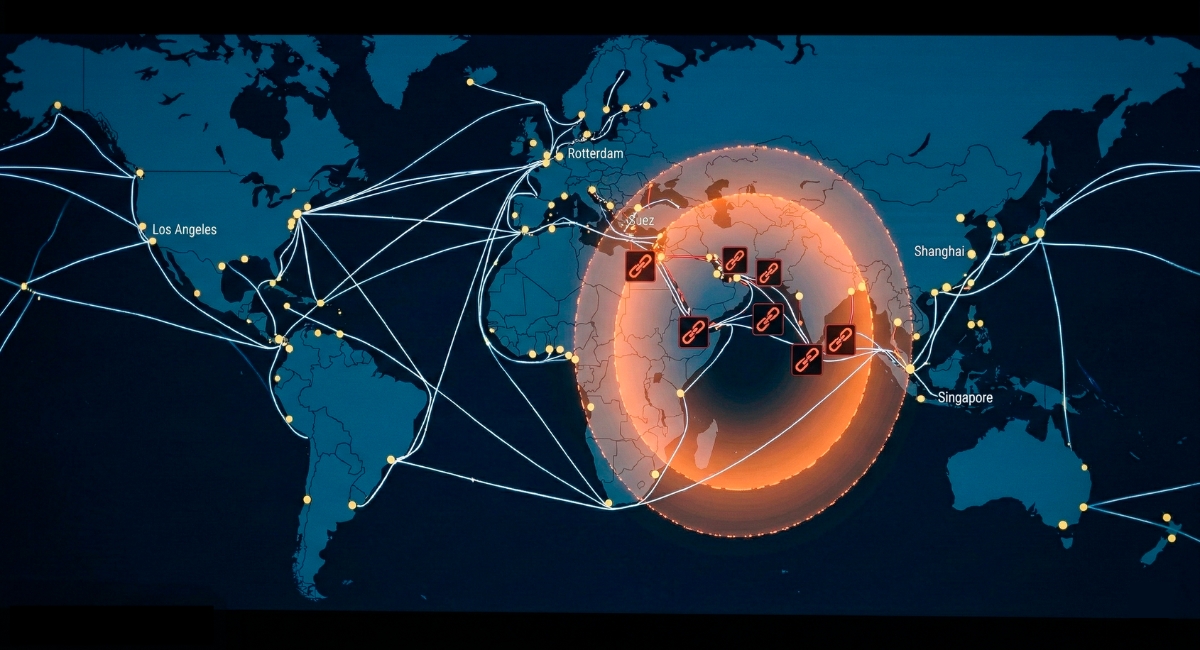
The war between Iran, the United States, and Israel is already reshaping operating conditions in the Gulf in real-time, particularly regarding transit continuity, capacity availability, and cost resilience. From the very first day of the conflict, logistics entered “crisis mode,” driven by two critical factors: the strategic importance of the Strait of Hormuz for global energy flows and the speed at which maritime security was reclassified as a high-risk area.
The environment, however, had been deteriorating for months. The escalation between Israel and Iran in June 2025 served as a significant precedent, with military actions and retaliations raising regional alert levels, especially for critical infrastructure and transit corridors.
February 28, 2026, marks the beginning of this new phase: the USA and Israel initiated hostilities with a coordinated strike against targets in Iran, and the Iranian response had an immediate impact on commercial traffic. Maritime security sources (JMIC via UKMTO) reported missile and drone attacks against merchant vessels in the Gulf and the approaches to Hormuz, elevating the regional risk level to CRITICAL.
From this point forward, the focus is no longer on the geopolitical outcome, but on what happens to supply chains when such a vital artery becomes unstable. We will focus on these consequences and the most plausible short-term scenarios in the following sections.
Closure of the Strait of Hormuz: What to Expect?
The escalation in Hormuz is already having a measurable effect on logistics fundamentals: energy costs, bunker prices, operational risk, and tonnage availability. Reuters notes that approximately one-fifth of the world’s daily oil consumption passes through the Strait; this is why the market immediately prices in any security downturn.
Regarding the closure, two levels currently coexist. Iran has announced a blockade and threatened the use of force against vessels attempting to transit. While maritime security operations centers (JMIC via UKMTO) have not confirmed a formally recognized closure, they describe an environment where attacks on commercial units have already occurred and where the regional risk is classified as CRITICAL. MARAD, for its part, recommends avoiding the area whenever possible.
For container shipping managers, the reality is that the route becomes unstable even without a total blockade. We are entering a regime where ETAs lose reliability as conservative decision-making increases: waiting periods, rescheduling, port rotation changes, speed reductions, or postponed transits. This immediately impacts schedule reliability and shifts operations from standard planning to exception management.
Fuel is the second variable moving rapidly. If the risk remains elevated, the risk premium is reflected in energy and bunker prices, eventually trickling down into freight rates via fuel adjustments and extraordinary security surcharges. While the effect is most direct on routes connected to the Gulf, the pressure on bunker prices tends to propagate further, as it affects operating costs across a wide range of services.
Finally, there is the issue of capacity. In high-risk areas, commercially available capacity no longer aligns with nominal capacity: some services are scaled back, certain bookings are restricted, and space availability becomes more selective. At that point, prices react as the market always does when effective supply tightens.
Airspace Restrictions and Hub Fragmentation
The first logistical consequence of the conflict was the fragmentation of airspace into a sequence of short-notice closures and restrictions, with immediate effects on flight frequencies, routing, and cargo capacity. On February 28, EASA issued a Conflict Zone Information Bulletin for the Middle East and the Persian Gulf, which was later extended on March 2 until March 6, designating the area as high-risk for flight operations.
The market impact was seen in the suspension and cancellation of connections to various hubs in the Gulf and the Levant, with partial resumptions being continuously recalibrated based on the security situation. Reuters has documented decisions by multiple international carriers to halt or reduce operations.
For international logistics, the bottleneck is effectively usable capacity: as belly capacity and frequencies are reduced, cargo space contracts and concentrates on alternative corridors that are longer and more saturated, putting pressure on spot rates and confirmation reliability. The impact on container shipping is indirect but operational: a portion of urgent cargo shifts back to sea freight, while reduced air connectivity complicates exception management, particularly for critical spare parts and components. Should this disruption persist, it is reasonable to expect higher costs for urgent shipments and less stable delivery windows for supply chains that utilize the Gulf as a hub or transit corridor.
Booking Embargoes and Supply Chain Contraction
In the Gulf, the impact is already visible in carrier policies. Maersk has suspended the acceptance of reefers and certain categories of special or dangerous cargo to and from several countries in the area, directing customers toward alternative solutions where available. Hapag-Lloyd has suspended reefer bookings to and from the Upper Gulf, Arabian Gulf, and Persian Gulf, signaling possible operational repercussions on vessel movements and regional port activities.
These measures reduce effectively usable supply and increase cargo selectivity, particularly for goods with higher operational complexity. Reuters reported that a significant portion of the container fleet is slowed down or held up in the Hormuz area, and some carriers have suspended direct bookings to the Middle East, risking backlogs and delays at connecting ports.
For shippers, the immediate effect is increased instability regarding confirmations and ETAs. Rolled cargo becomes more likely, and shipments are frequently pushed to subsequent departures. Beyond freight rates, risk-related components are rapidly being introduced. Hapag-Lloyd has announced a War Risk Surcharge applied to cargo to, from, or transiting through the Gulf area. In this phase, service continuity is what matters most, utilizing sustainable routing and lead times realigned to current operating conditions.
Insurance Markets and Underwriting in Conflict Zones
In an area classified as high-risk, service continuity depends first and foremost on insurability. If war risk coverage is canceled or renegotiated under prohibitive conditions, the route remains theoretically navigable but becomes commercially fragile. Currently, the difference between operating and halting often depends on premiums, deductibles, coverage limits, and requirements imposed by shipowners, charterers, and financiers.
In recent days, several insurers have issued notices of cancellation for war risk coverage in the region. Gard issued a notice of cancellation, and Skuld published a similar communication, taking effect after the standard notice window indicated in their respective circulars. Reuters has linked this move to a spike in insurance premiums and a further slowdown in operations, particularly in the Gulf.
Operationally, cancellation does not mean an absolute absence of coverage. It means a reopening of negotiations on short notice, resulting in more expensive and selective conditions. Simultaneously, the relevance of the contractual framework grows, as many transport and chartering structures include deviation or cancellation clauses when a route is deemed unsafe. Gard, in its analysis of the contractual and insurance implications of the conflict, highlights how the evolution of coverage impacts operational decisions and liability management.
For container shipping, the effects on costs and capacity are immediate. Costs rise due to the insurance component and tend to be reflected in surcharges or more rigid pricing terms. Capacity becomes less elastic as part of the supply is reallocated or operates under constraints that reduce commercial flexibility, leading to greater variability in ETAs and delivery windows.
The situation remains highly volatile. The IMO urges maximum caution and, where possible, recommends avoiding transit in the region until conditions improve. In this context, effective management relies on frequent updates regarding available coverage and carrier policies, alongside planning that incorporates realistic margins for both time and cost.
At CTI, we daily monitor carrier operational updates, maritime security center directives, and signals from the insurance market. If you have shipments in progress or planned for corridors connected to the Gulf, we encourage you to contact us for a precise assessment of the impact on timing and costs, and to define a shipping strategy consistent with the evolving risk.