







At the end of January 2026, the European Union and India announced the conclusion of negotiations for a Free Trade Agreement (FTA) that, given the scale of the economies and populations involved, is set to significantly reshape global trade routes. This is not merely about “cutting tariffs”: it is about making it easier, more predictable, and often faster to buy and sell between two markets that are already highly interconnected, yet still constrained by high duties and administrative procedures that are not always straightforward.
Where we stand and what truly changes
To begin with, it is worth clarifying that the agreement follows a lengthy process: negotiations began in 2007, were subsequently suspended, and resumed in 2022, leading to the political conclusion reached in January 2026.
As for what will concretely change, EU institutions refer to a very broad liberalisation. In essence, India will eliminate or reduce tariffs on a substantial share of European exports; on the EU side, market access for Indian products will become easier across a large number of tariff lines. The European Commission also highlights the expected economic impact: the agreement is projected to significantly boost EU goods exports to India by 2032 and generate annual tariff savings of approximately €4 billion.
Tariffs, services and rules: the agreement’s key levers
Historically high tariffs on many product categories have made India a “promising yet demanding” market for numerous European companies. The FTA addresses precisely these obstacles through tariff reductions, streamlined procedures, and a more stable framework for exporting. For instance, the Commission’s Q&A document refers to substantial cuts for sectors such as machinery, chemicals and pharmaceuticals, as well as a marked tariff reduction path for automobiles, including tariff-rate quotas.
In addition, there is a services chapter of considerable value for companies operating within international supply chains: more predictable access to the Indian market in areas such as financial and maritime services, with commitments described as “ambitious” by the Commission.
There is also a topic that is often underestimated until goods are actually shipped: rules of origin. These determine when a product can benefit from preferential tariff treatment. In other words, simply routing goods through India or the EU is not sufficient; substantial transformation and proper documentation are required, precisely to prevent circumvention through triangular trade.
What does the EU import from India?
Official figures are instructive: in 2024, the EU imported goods from India worth approximately €71.3 billion, reflecting growth compared to the previous year.
In terms of composition, the most significant categories include machinery and transport equipment, chemicals, metals and semi-finished products, mineral products, and textiles.
What does the EU export instead?
Conversely, in 2024 the EU exported approximately €48.8 billion worth of goods to India.
The main categories are consistent with Europe’s industrial specialisation: machinery and equipment, transport equipment, and chemical products. This underscores a practical point: the agreement is not merely about “more trade”, but about trade that is often technology-intensive, where customs clearance times, certifications and logistical reliability make a decisive difference.
Impacts on international logistics and container shipping
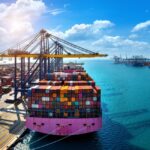
What does this mean in practical terms for those moving goods? If tariffs decline and procedures become simpler, trade flows are likely to increase, placing additional pressure on ports, feeder services, inland terminals and warehouses, particularly along Asia–Europe routes. At the same time, three operational aspects become even more critical: accurate customs classification, management of preferential origin, and meticulous document planning, since access to FTA benefits depends precisely on these elements.
Another key factor is predictability. A “modern” agreement seeks to reduce the grey areas created by divergent interpretations, additional requests and variable timelines. For companies shipping containers on a regular basis, this often translates into fewer unexpected delays and improved arrival planning—especially when production windows or just-in-time deliveries are involved.
Sustainability, labour and compliance
The FTA also includes commitments on trade and sustainable development: environment, climate, labour rights and enforcement mechanisms. It is important to remember that these chapters are not merely symbolic; over time, they can influence traceability requirements and controls throughout the value chain.
Moreover, for many European companies, compliance is already a daily reality involving declarations, audits and supply chain standards. The agreement may facilitate increased sales, but it does not replace the need for robust oversight of documentation and processes.
How to prepare for the EU–India agreement: practical advice
First and foremost, it is advisable to map products and routes: which customs codes, which Incoterms, which facilities and which processing stages affect origin. It is also worth noting that India and the EU already maintain significant volumes: in 2024, bilateral trade in goods reached approximately €120 billion. The agreement therefore builds on a concrete foundation, not on an abstract promise.
Finally, turning the FTA into a competitive advantage requires strong logistical coordination: port selection, transit times, buffer stocks and, above all, structured customs management without improvisation. If you would like to understand how the EU–India agreement may impact your shipments, costs, timelines and documentation, do not hesitate to contact CTI. We can help you interpret the new landscape and develop a tailored operational strategy, supporting you step by step—from customs consultancy through to container shipment planning.